How to Cite
Abstract
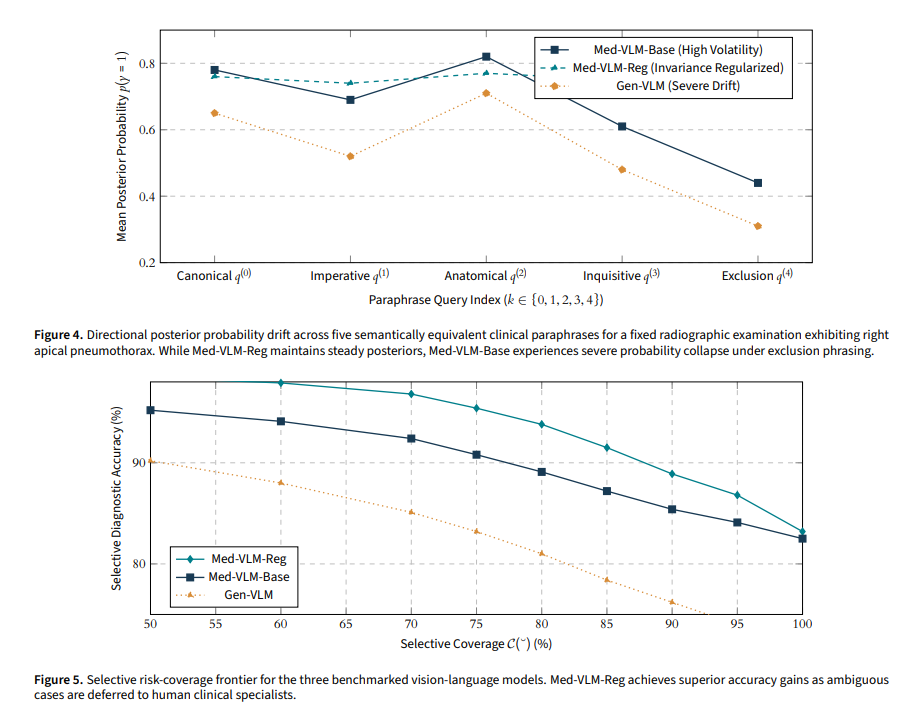
Clinical deployment of multimodal foundation models requires evidence that extends beyond summary accuracy metrics. When deep visionlanguage architectures are evaluated solely through scalar discrimination indices such as top-1 accuracy or area under the receiver operating characteristic curve, critical failure modes remain obscured. Models that appear statistically equivalent under aggregate evaluation often exhibit dramatic disparities in calibration, semantic consistency under clinical paraphrasing, subgroup vulnerability, and downstream decision utility. This paper establishes a formal multiaxis evaluation framework specifically formulated for clinical vision-language systems. We formalize evaluation across four orthogonal dimensions: discriminative capability, uncertainty calibration and reliability, linguistic robustness under semantic-preserving perturbations, and workflow risk-coverage trade-offs. We prove that single-index summaries introduce irreversible information loss that can mask severe safety vulnerabilities in medical triage. Through an illustrative evaluation protocol spanning 1,200 chest radiograph diagnostic queries with paired semantic variations, we demonstrate how multidimensional auditing uncovers latent instability. We formulate rigorous diagnostic estimands, define operational validity checks, and synthesize evidence across contemporary evaluation benchmarks. Our framework provides clinical AI developers, hospital procurement committees, and regulatory bodies with an axiomatic methodology to evaluate whether vision-language models satisfy the safety and reliability thresholds required for high-stakes healthcare deployment.